Showing posts with label Hacking. Show all posts

Sunday, March 29, 2015

Mysterious alien cell towers called ‘Interceptors’ snooping on US citizens pinpointed


Spy cell towers called 'Interceptors,' a new enemy snooping on you

All of the mysterious cell phone towers in the U.S. can now be pinpointed and most of them dont belong to US government says Les Goldsmith, the CEO of ESD America. He made this observations while launching a real-time service called Overwatch to pinpoint these interceptors.
Goldsmith said that ESD America was the only company which had systems in place to locate these private spy towers. The towers are called IMSI catchers, for the International Mobile Subscriber Identity that is attached to every cell phone. They mimic legitimate cell towers and reroute nearby cell transmissions through them. But they’re not phone company equipment. ESD said it discovered the IMSI catchers in the course of testing the company’s military-grade secure Cryptophone 500 cell phone.
ESD found 17 towers initially across the US and now the figure had jumped up to 54. Goldsmith said that the interceptors could be a listening/call-handling box. Surprisingly ESD discovered more than a dozen interceptors near the U.S. Senate and White House.
While it was speculated that these interceptors belonged to NSA and its sister agencies, Goldsmith is quick to rubbish this possibility. He says NSA has enough muscle to directly tap into the phone calls instead of erecting these innocuous towers.
Asked about whether these Interceptors were made in the United States, “We believe a majority of them are non-U.S. government,” he told VentureBeat “Looking at the types, the sophistication, [there are]more foreign than domestic.” The largest percentage uses open source OpenBTS, he said, suggesting they are laptop devices used by a hobbyist.
“If you are U.S. [government], you use U.S.-made,” he said, because it is reliable technology. He added that U.S. technology for IMSI catchers shouldn’t be exportable, under International Traffic in Arms Regulations (ITAR).
ESD says it will offer its new interceptor-catching service only to the U.S. government, and to other governments “strictly allied” with the U.S. When it was pointed out to Goldsmith that the ESD website promoting the new service doesn’t mention that, he told me it would be added.
“We want the government to be able to catch” those setting up these towers, he said. If the U.S. and friendly governments don’t want the service, Goldsmith said, “we won’t supply it.” Goldsmith states that at least 14 foreign governments have evinced interest in the ESD’s services.
The interceptor hunting is conducted with ESD-built, briefcase-sized sensing devices that the company deploys in an area. The tech sets up a “firewall” that monitors connections to cell towers from ESD devices. Goldsmith said the service doesn’t monitor individual messages.
Goldsmith said that these interceptors can be detected with Samsung Galaxy S3, S4, or S5 smartphones which have to be modified to detect and report back the interceptors’ locations. Cryptophones can also detect the IMSI catchers, but they are not designed to report back the data.
The Federal Communications Commission (FCC) has announced an investigation into the unauthorized use of IMSI catchers.
Resource : VentureBeat.
A class of people are happy, a few are neutral and some of them are angry with the way it has been going on in the country. In this latest video message, hacktivist group Anonymous has targeted US President Barack Obama for his imperial style of Presidency. Anonymous said in the video:
Until they become conscious they will never rebel, and until after they have rebelled they cannot become conscious
Anonymous has targeted Obama administration for various issues. They said:
The controversial bills that have been Passed and actions like defending the wall street banks like Bank of America and other commercial banks and credit card companies. Helping banks rather than helping home owners with their debts,  not Reducing debts from main street instead of wall street are some of the actions that have created quite a stir among the citizens. Make no mistake about it: this is not about national security. 

Hactivist group Anonymous didn’t stop there and continued to lash out the American government:
Warrantless wire tapping and other access are eroding the civil liberty. People are witnessing slow and steady takeover of their true freedom. The government taking over banks, insurance companies, car companies!! Telling them what cars to drive. And now taking control over health care. American people are forced to do something they do not want to do. Government should not be in control, people should. Obama administration may subvert the constitution. Total power in one person’s hand is not the American way. People are now not believing in the government and its agenda. There is only one option left: just be true to the people. 

$250 laptop bought from random listing on Craiglist lands a man in prison

Buying $250 laptop from a random listing on Craiglist lands a man in prison


Murphy’s law : If anything can go wrong, it will. This is what happened with a Redditor, Sunday_Account, about six months ago. Mr.Sunday_Account had a nice job with a company which worked for a federal agency. The only thing about working with this company was the security clearances which Mr.Sunday_Account got.
In his own words,  “To get this job, I had to pass a security clearance which involved some agency calling all of my former employers, my family, and even my friends. I passed with no problem and about 6 months from the initial application, I started working.”
Everything as going quite well when one day Sunday_Account spilled coffee on his laptop and it went bust. Being a miserly sort of man, he opened Craiglist to check for a cheap second hand laptop. Pretty soon he found a random listing for a Samsung ATIV with i5 processor for $300.
Sunday_Account emailed the man who made the listing and he answered back. Subsequently they agreed to meet up at a coffee house. Sunday_Account found the man to be a little bit shaky but sadly was keen to fix up a cheaper deal to notice his discomfort.
“I met the guy at a coffee shop. He was shaky; I mean he was crackhead shaky. He was well-dressed but something wasn’t right about the kid. I fired up his laptop, it booted instantly….I checked the HDD space, memory, CPU, etc. Everything was fine. Creepy guy looked like he was in a rush so I did a speed negotiate with him and walked out the door with his computer for $250. Yeah! I saved $50.
Next day, our man had to attend a briefing on a new project at a new government agency. He arrived at the agency and underwent the security screening process and all hell broke loose.
“Questions were asked and answered, phone cameras were disabled via software, and laptops were scanned and their cameras were disabled. The guy working on my laptop called his supervisor and then his supervisor called another guy and next thing I know I’m in a room with four guys grilling me on the content of my computer.”
The next thing he knew was there were handcuffs in his hands and he was shoved off to jail. The authorities had caught him red handed with illegal adult material on his HDD and he was going to pay for it.  He could get bail for three days however during that time he contacted a lawyer.
Luckily for him, Sunday_Account had narrated his Craiglist and the seller guy in coffee shop episode to his colleagues back at the office. The lawyer believed him and cross checked with his colleagues. He also had PI track down the guy who had made the listing on Craiglist.  It turned out that the guy who made the listing was a registered sex offender.
It took a month for all the charges against Sunday_Account to be dropped and his arrest record to be erased. The $250 lappy cost him $12,000 in legal bills for the entire fracas.
Sunday_Account made a post of his ordeal on TIFU subreddit where he advised fellow Redditors and other readers to “reformat the drive on any used computer you buy or eat bologna sandwiches with retards in jail.”

Hijacked school Twitter account turns head teacher into a porn star


Cyber Criminals hack Twitter account of school, turn the head teacher into adult film star


Hackers do some really crappy things to the hijacked accounts but this one takes the cake. Cyber criminals hijacked the Twitter account of a head teacher of Oriel High School and turned him into a adult film star and complete with all the makeup and stuff.
Philip Stack, who is head teacher of Oriel High School in United Kingdom faced one of those days when everything you do goes wrong. First his Twitter account was hijacked and later the hackers turned him into a adult film star with a liberal dose of photoshopping. The final nail in Stack’s day was that hackers used his Twitter account to make inappropriate and unceremonious tweets about his girl students.
Some of the tweets are as follows :
The year 9 girls are getting a bit fat.
We need to work on them in the gym.
The Mirror reported on Wednesday, the image of Oriel High School head teacher Philip Stack’s smiling face was pasted onto the body of a muscular, tattooed male model who would have been naked but for a jock strap.
Cyber Criminals hack Twitter account of school, turn the head teacher into adult film star
The school immediately deactivated the account and informed the police who are investigating the hack attack.
Prima facie it seems that the Twitter was hacked by students themselves and that is what some Twitter users suggested. One users sarcastically added that Oriels’s IT teachers should be proud of students’ “accomplished computer skills.”
bitcoin

Since 2008, bitcoin adoption has been influenced by a diverse range of factors that have made it one of the most volatile currencies in the world. Yet, despite such volatility, more than 100,000 bitcoin transactions aretaking place per day and the volume continues to grow due to the ‘permissionless innovation’ provided by bitcoin’s underlying technology, the blockchain.
As the blockchain matures, bitcoin will increasingly resemble traditional financial services, with functions such as retail banking (Circle), exchanges (Coinbase) and payment processors (bitnet) being created. But how did it all start off, and where will it go next? Here, we take a brief overview of the major milestones in the cryptocurrency’s brief history and look to where it might be headed in the future.

August 2008

Three individuals, Neal Kin, Vladimir Oksman, and Charles Bry file an application for an encryption patent application. All three individuals deny having any connection to Satoshi Nakamoto, the alleged originator of the Bitcoin concept. The three also register the site Bitcoin.org in the same month, over on anonymousspeech.com – which allows people to buy domain names anonymously.

Bitcoin by zcopley on Flickr 520x199 A brief history of bitcoin   and where its going next

October 2008

Despite the above, Satoshi Nakamoto releases his white paper, revealing his idea for a purely peer-to-peer version of electronic cash to the world. In his vision, he manages to solve the problem of money being copied, providing a vital foundation for Bitcoin to grow legitimately.

Janaury 2009

The first block, nicknamed ‘Genesis’ is launched allowing the initial ‘mining’ of Bitcoins to take place. Later that month, the first transaction takes place between Satoshi and Hal Finney, a developer and cryptographic activist.

October 2009

Bitcoin receives an equivalent value in traditional currencies. The New Liberty Standard established the value of a Bitcoin at $1 = 1,309 BTC. The equation was derived so as to include the cost of electricity to run the computer that created the Bitcoins in the first place.
475512651 520x346 A brief history of bitcoin   and where its going next

February 2010

The world’s first Bitcoin market is established by the now defunct dwdollar.

May 2010

A programmer living in Florida named Laslo Hanyecz sends 10,000BTC to a volunteer in England, who spent about $25 to order Hanyecz a pizza from Papa John’s. Today that pizza is valued at £1,961,034 and stands as a majormilestone in Bitcoin’s history.

August 2010

Bitcoin is hacked. A vulnerability in how the system verifies the value of Bitcoin is discovered, leading to the generation of 184 billion Bitcoins. The value of the currency – from a high of $0.80 to $1 in June drops through the floor.

October 2010

Bitcoin goes under the spotlight. After the hack in August – and a subsequent discovery of other vulnerabilities in the blockchain in September – an inter-governmental group publishes a report on money laundering using new payment methods. Bitcoin, it suggested could help people finance terrorist groups.

November 2010

Bitcoin reaches $1 million. Based on the number of Bitcoins in circulation at the time, the valuation leads to a surge in Bitcoin value to $0.50/BTC.
167577081 520x200 A brief history of bitcoin   and where its going next

January 2011

The Silk Road, an illicit drugs marketplace is established, using Bitcoin as an untraceable way to buy and sell drugs online.

February 2011

Bitcoin reaches parity with the US dollar for the first time. By June each Bitcoin is worth $31 giving the currency a market cap of $206 million.

June 2013

The first major theft takes place. Bitcoin Forum founder allinvain reports having 25,000 BTC taken from his digital wallet, which had an equivalent value of $375,000. In the same month, a major breach of security sees the value of the currency go from $17.51 to $0.01 per Bitcoin.

March 2013

​The US Financial Crimes Enforcement Network (FINCEN) issues some of the world’s first bitcoin regulation in the form of a guidance report for persons administering, exchanging or using virtual currency. This marked the beginning of an ongoing debate on how best to regulate bitcoin. 

March 2013

Bitcoin market capitalisation reaches $1bn.
2120x1192 adafruit bitcoin banner 1 520x292 A brief history of bitcoin   and where its going next

August 2013

Federal Judge Mazzant claims: “It is clear that Bitcoin can be used as money” and “It can be used to purchase goods or services” in a case against Trendon Shavers, the so-called ‘Bernie Madoff of bitcoin’. Bloomberg begins testing bitcoin data on its terminal. Although alternative tickers exist, endorsement from Bloomberg gives bitcoin more institutional legitimacy.

November 2013

Bitcoin price climbs to $700 in as the US Senate holds its first hearings on the digital currency. The Federal Reserve chairman at the time, Ben Bernanke, gives his blessing to bitcoin. In his letter to the Senate homeland security and government affairs committee, Bernanke states that bitcoin “may hold long-term promise, particularly if the innovations promote a faster, more secure and more efficient payment system”.

December 2013

China’s central bank bars financial institutions from handling bitcoin transactions. This ban was issued after the People’s Bank of China said bitcoin is not a currency with “real meaning” and does not have the same legal status as fiat currency. The ban reflects the risk bitcoin poses to China’s capital controls and financial stability. Today China remains the world’s biggest bitcoin trader, with 80% of global bitcoin transactions being processed in China.
bitcoin crop 520x520 A brief history of bitcoin   and where its going next

January 2014

Bitcoin custodians Elliptic launch the world’s first insured bitcoin storage service for institutional clients. All deposits are comprehensively insured by a Fortune 100 insurer and held in full reserve. This means Elliptic never re-invests client assets; instead they secure them in deep cold storage. Overstock.com becomes the first major online retailer to embrace bitcoin, accepting payments in the US. Overstock was the first in what is now an expeditiously growing list of large businesses that accept bitcoin.

February 2014

HMRC classifies bitcoin as assets or private money, meaning that no VAT will be charged on the mining or exchange of bitcoin. This is important as it is the world’s first and most progressive treatment of bitcoin, positioning the UK government as the most forward thinking and comprehensive with regard to bitcoin taxation.

June 2014

The US government auctions off more than 29,000 bitcoins seized from the Silk Road, the illegal online marketplace. The sale and closure of the marketplace marks growing institutional understanding of the potential use cases of bitcoin. Additionally, the closure and auction of the Silk Road has helped bitcoin gain legitimacy as it demonstrates that bitcoin is not an easy way for online criminals to avoid the rule of law.
From this point onwards bitcoin can no longer be considered as a currency for criminals. The use of the bitcoin blockchain means that the identity of users can often be established.

July 2014

The ‘Bit Licence’ edges towards reality as the New York State Department of Financial Services releases the first draft of the agency’s proposed rules for regulating virtual currencies. The European Banking Authority publishes its opinion on ‘virtual currencies’. Their analytical report recommends that EU legislators consider declaring virtual currency exchanges as ‘obliged entities’ must comply with anti-money laundering (AML) and counter-terrorist financing requirements.
Bitcoin accepted here printable 520x198 A brief history of bitcoin   and where its going next
The EBA report is important as it acts as a catalyst to launch bitcoin into the financial mainstream by highlighting the fact that virtual currencies require a regulatory approach to strive for an international coordination to achieve a successful regulatory regime.
Also that month GABI (Global Advisors Bitcoin Investment Fund) launches the world’s first regulated Bitcoin Investment fund. This is important to the bitcoin ecosystem as the launch of this investment vehicle adds further legitimacy to bitcoin in addition to allowing regulated investors a way to invest in bitcoin.

August 2014

The Chancellor of the Exchequer, George Osborne, demonstrates his and HM Treasury’s positive outlook on bitcoin when he purchases £20 worth of bitcoin and announces HM Treasury’s Call for Information on digital currencies, offering digital currency businesses the chance to comment on the risks and benefits and potentially influence future government policy.

October 2014

TeraExchange announces that the first bitcoin derivative transaction was executed on a regulated exchange, adding a new hedging instrument to bitcoin and instilling credibility and institutional confidence in the entire bitcoin community.  

December 2014

January 2015

The New York Stock Exchange is a minority investor in Coinbase’s $75M funding round. The NYSE aims to tap into the new asset class by bringing transparency, security and confidence to bitcoin.

March 2015

The results of the UK Treasury’s call for information on digital currency are announced.

Future predictions

There are several possible ways Bitcoin can go at this point, all of which point to a legitimate, widespread adoption by large institutions through tighter regulation. Recently, New York’s BitLicense became the world’s first digital currency-specific regulatory regime. It has been through a couple of rounds of consultations and is expected to come into force in a couple of weeks.
The European Central Bank and European Banking authority have both released detailed reports on digital currencies, and suggested regulation of the industry by the EU to further control price fluctuations. The Winklevoss brothers, they of Facebook fame, are on the verge of launching their own exchange-traded fund holding Bitcoins.  
Bitcoin’s journey into the financial mainstream has already begun, with HM Treasury’s report on digital currencies marking encouraging progress toward the predictions in this infographic. The report introduces anti-money laundering, consumer protection and technical standardisation for digital currency companies in the UK, which will encourage traditional financial services to engage more with digital currency businesses and accelerate the integration of blockchain technology within financial services.

hackaball-programmable-toy-teaches-kid-code-
Could a toy teach coding? Are we moving towards having Programming Languages in Kindergarten?


Technology has advanced at every level. Now geeks are targeting the very roots of society. Different toys have been helping children learn basics. Abacus teaching mathematics; digital toys teaching alphabets and of course building blocks. It is certainly tough to describe generations of toys from Rubik’s cube to Hackaball. Hackaball is a smart toy which teaches kids of age group 6 to 10 to invent, program and play games using an iPad app.
Hackaball started as an intern project focused on providing children a different way of understanding technology. Later they tested with seven prototype Hackaballs and a hundred children and parents. The exciting response from kids encouraged the developers to improve and bring Hackaball into the tech market.
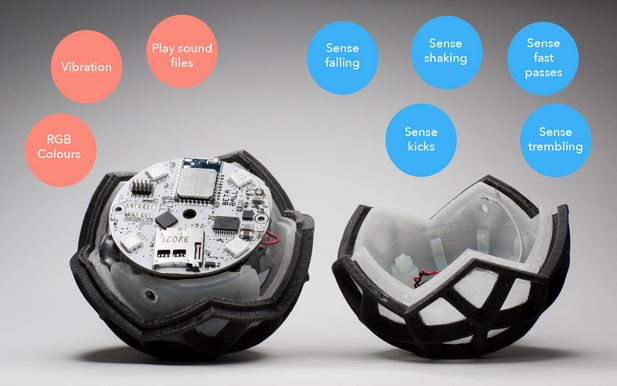
Hackaball is operated through an iPad app. There is a computer inside which connects to iPad wirelessly. Rest of the working of Hackaball is based on coordinating jobs of a gyro, accelerometer, vibration motor, LEDs, rechargeable battery, memory to store sounds and a speaker.
The computer, sensors and displays at the centre of Hackaball are placed inside a tough transparent plastic case which surrounded by a circular silicone membrane. The membrane acts as a shock absorber, fitting between two translucent rubber hemispheres. Another stretchable outer covering made of colorful silicone skin with perforated circles provides extra strength. Glowing LEDs add to the effect of patterns.
hackaball-programmable-toy-teaches-kid-code
The sensors inside Hackaball sense the motions of ball such as bouncing, shaking or remaining still. The ball is hacked by iPad and it’s actions are decided accordingly. It is all based on the basic if and then logic. The iPad app has already loaded games; after getting the touch one can go on experimenting and developing games on his own.
Hackaball is developed by Map and Made by Many. Map studio responsible for electronics and design and Karl Sadler for setting up sound effects. It was launched on Kickstarter - a community dedicated to bring new technologies and ideas into world.
Watch the Kickstarter promotion video of Hackaball:

High School in Louisiana suspends 45 students for illegitimate hacking and increasing grades

45 Students Suspended for Hacking into High School Website to Increase their Grades


Using hacking to increase grades is not new but to making a enterprise out of it is.  This was discovered by the system admins of Beau Chene High School in Arnaudville, Louisiana. The school authorities have suspended at least 45 students during past one and half months for illegally enhancing their educational scores by hacking into the PowerSchool software used by the school to keep track of student grades.
The students involved seems to a part of greater ring of a group who take money and other considerations from students for increasing their school grades. The school authorities said that the actual procedure of hack was not known but the hackers gained illegal entry into the software by using legitimate set of credentials.
Most schools in United States use a web application called PowerSchool which offers access to grades to teachers, parents and students.
An plausible explanation for the hackers using legitimate set of credentials was given by a senior student at Beau Chene who said that one of his colleagues may have obtained the password of a full-time teacher after they left. This set of credentials may have been passed on to the hackers according to him.
The hacker or a group who operated the enterprise sometimes took money for enhancing the grades while at other times took sexual favours as per reports. The hacker (s) also used their hack and illegal access to reduce grades of students they didnt like.
Keith James, principal of the school, said that institution was tipped by a concerned parent and then he asked teachers to look into PowerSchool for irregularities. He said that the school had suspended those 45 students who were aware that their grades were enhanced illegally but as of now the school authorities dont know the actual number of students involved or being victim of this hack.
As a precaution, the district’s IT department has enhanced the security measures for PowerSchool in order to detect modification of the grades at an earlier stage.

Researcher develop technique for stealing data from computers which are not connected to Internet using heat generated by them

Hacking the Air-gapped computers using heat generated by them


Earlier we had brought you a research paper published by University of Georgia where the researchers managed to steal data from air-gapped computers using ‘side channel signals.’ Stealing from computers not connected to internet became that much more easier using the new technique found by security researchers from Ben Gurion University.
Security researchers from Ben Gurion University in Israel have found a way to retrieve data from air-gapped computers i.e. computers not connected to internet, using only heat emissions and a computer’s built-in thermal sensors.
The research team consists of Mordechai Guri, Gabi Kedma and Assaf Kachlon and are overseen by their adviser Yuval Elovici.
Together they have devised a method which could be used potential hackers to steal passwords from a protected system and transmit the stolen data from a internet connected PC in close proximity to their command and control center.
Computers produce varying levels of heat depending on how much processing they’re doing. PCs have built in thermal sensors to monitor such heat and give commands to the internal fan to start or switch off.
The attack, which the researchers dubbed BitWhisper, uses these sensors to send commands to an air-gapped system or siphon data from it. The technique works a bit like Morse code, with the transmitting system using controlled increases of heat to communicate with the receiving system, which uses its built-in thermal sensors to then detect the temperature changes and translate them into a binary “1” or “0.”
The researchers have published the video of the Proof-of-Concept which can been seen below

In the video demonstration, the researchers are able to send command from their source PC to the target air-gapped PC to re-position the missile launch toy which the air-gapped PC controls.
Since the method requires that the target PC be infected by a malware first, they can also send malicious commands to the air-gapped target PC using same heat and thermal sensors. As of now the PoC attack allows just eight bits of data to be reliably transferred over an hour. However this time is enough for cyber criminals to steal passwords and secret keys or give malicious commands.
The researchers stated that the PoC attack only works if the target air-gapped PC is within 40 centimeters or 15 inches from the control PC. The researchers howevers state that this shouldnt pose a problem as all air-gapped classified PCs often sit on desktops alongside Internet-connected ones so that workers can easily access both.
Further the researchers say that this is only the first step and they expect it to be foundation for other researchers to work on. 
“We expect this pioneering work to serve as the foundation of subsequent research, which will focus on various aspects of the thermal channel and improve its capabilities,” the researchers note in their paper. With additional research, they say they may be able to increase the distance between the two communicating computers and the speed of data transfer between them.
They will present their findings at a security conference in Tel Aviv next week.
Resource : Wired

Neil Moore, a convicted fraudster tricks the prison officers to let him go free, by faking an email ordering his release

Prisoner fakes bail email to escape from the prison


The convict who was locked up in England’s Wandsworth Prison for stealing £1,819,000 with online fraud methods in some cases acting like a bank staff using voice impersonation to trick victims in giving him large amounts of money.
Moore faked the ‘Bail Orders’ with an illicit mobile while he was on remand, he posed as a senior court clerk and sent bail instructions to prison staff, the bail instructions was sent from a fake web domain email which closely resembled to that of the original court domain.
His act came to light only after three days of his release from the prison when a solicitor who went to interview him found that he was already gone.
Prosecutor Ian Paton said: “A lot of criminal ingenuity harbours in the mind of Mr Moore. The case is one of extraordinary criminal inventiveness, deviousness and creativity, all apparently the developed expertise of this defendant”.
The judge, Recorder David Hunt QC, described the behaviour as “ingenious” criminality.
Moore will be sentenced on 20th April for eight counts of fraud and one count of escape from prison.
Resource: BBC

Hacking guru and security consultant, Kevin Mitnick enthralls CeBIT 2015 audience with live hacks

Hacking Guru Kevin Mitnick hacks CeBIT 2015 audience


Well known hacker and now a security consultant enthralled the audience at CeBIT 2015 by presenting three live hacks.
Kevin Mitnick who once found the spot on the FBI’s Most Wanted list for his hacking skills and underwent prison sentence for the same, is now a well known security consultant. Kevin and his team have been on the roster of several big tech firms including Fortune 500 ones, and boasts of a 100 percent success rate in finding the weaknesses in their cyber defences.
Mitnick demonstrated a range of impressive hacks live on the CeBIT stage. He gained full control of targeted machines through use of weaponised USB drives, Wi-Fi access points, PDF files and more, as well as cloning wireless keycards that many companies use for building access, all within 15 minutes.
Kevin said in his address to the fascinated CeBIT 2015 crowd that he never used exploits or software 0-days to hack into the web defences. Instead he relied on a method called social engineering. Social engineering is a method to target the weakest link in the cyber defences of any company, its cyber security team.  Kevin says that instead of relying on the exploits and vulnerabilities it is much easier to target low level and less tech-savvy employees and gain access to the system.
Kevin who’s visiting card includes a fully functional lock-picking kit, has made hacking a full fledged career. He earned his title of ‘most famous hacker’ in 1990s when he entered the FBI’s most wanted cyber criminal list. He was awarded a two year prison period for hacking into some of world’s most formidable tech companies and websites like North American Air Defence Command.
Upon his release he again was back to his favourite game, hacking and again the law caught up with him, only this time his prison sentence was 5 years. In 1999, as part of a deal, he pled guilty to four counts of wire fraud, two counts of computer fraud and one count of illegally intercepting communications. The prison sentence included eight months in solitary confinement because a federal judge believed he could “whistle tones into a phone and launch a nuclear missile.”
Now aged 51, Kevin concedes that he hacked into computers belonging to companies like Motorola, Nokia and Sun Microsystems “for the pursuit of knowledge and adventure” and not for personal profit or to cause any meaningful harm.
These days, Mitnick is a highly paid and successful security consultant to some of the world’s largest companies including FedEx, Toshiba, CBS, IBM and Lockheed Martin. “My primary business is doing penetration testing,” he said. “We test the physical security, the technical security, the people. We test their wireless networks, their VOIP phones. We test everything across the board to look for vulnerabilities so our clients can fix them.”
And CeBIT hacks prove that the worlds most famous hacker hasnt lost his touch.

Slack Technologies Hacked: 500,000 Emails Exposed

Popular Chat room service Slack hacked, personal information of 500,000 users exposed


Popular chat room service, Slack was hacked in month of February 2015 and may have left a massive 500,000 users personal information like email addresses, phone numbers, Skype IDs and anything they might have added to their profiles exposed for spam attacks and identity thefts.
Slack has been gain popularity over past few months and has been valued at a whopping $2.8 billion by its investors. The hack was noticed by the Slack security team who made a post on their website announcing the same.
“We were recently able to confirm that there was unauthorized access to a Slack database storing user profile information. We have since blocked this unauthorized access and made additional changes to our technical infrastructure to prevent future incidents. We have also released two-factor authentication and we strongly encourage all users to enable this security feature.”
Though the hack occurred in February, it took more than a month for Slack to announce the hack. It also announced that it had enabled 2 factor authentication after the hack attack.
“This further highlights the need for all organizations – both startups and established companies – to invest in post-infection software that can quickly identify security breaches and prevent valuable data theft,” said Paul Martini, CEO of iBoss, a cybersecurity provider.
“We are collaborating with outside experts to cross-check assumptions and ensure that we are meticulous in our approach,” stated the company. “In addition we have notified law enforcement of this illegal intrusion.”
The blogpost said there were no indications of the financial and payment card information being compromised by the hackers and the hack attack lasted for approximately 4 days before its security team uncovered the same. It also said that it had started notifying the 500,000 users whose information has been exposed.
Slack has been criticized for its security practices in the past. In October 2014 for a design flaw which left its chat room names visible and open to anyone. After a furore online, Slack denied that the design flaw was a bug.

chinese-hacking-army-

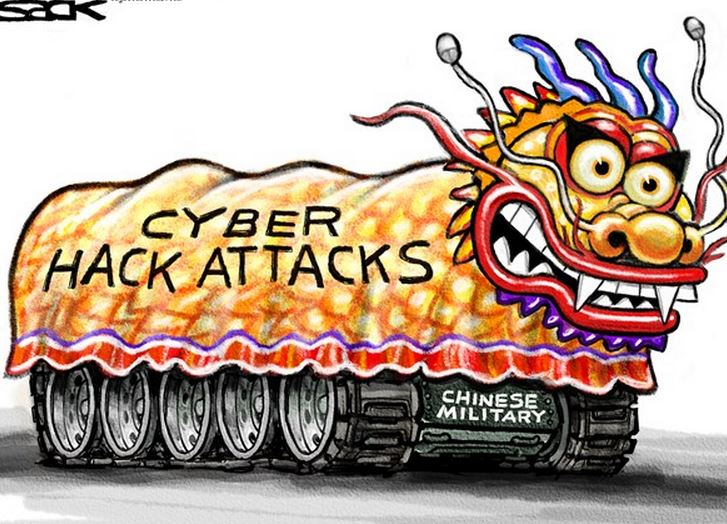
Well, something very unexpected has happened today. The fact that China is having an army of hackers isn’t surprising; instead, acceptance of this fact by China is shocking. United States, India and many other countries have been suspecting this communist nation for a long time for carrying out cyber attacks. But, the every instance and complaint made was denied by China in the past.
Now, China has decided to unveil the curtain covering this mystery. The latest edition of The Science of Military Strategy, which is a respected analysis of Chinese military actions and thinking, has written about China’s cyber-warfare army.
A Chinese military strategy expert at the Center for Intelligence Research and Analysis, Joe McReynolds told the Daily Beast that China has accepted the fact that it uses hackers and cyber-warfare units. He called this release as a “once in a generation” document. For the first time, China has said, “Yes, we do in fact have network attack forces, and we have teams on both the military and civilian government sides.”
Back in the year 2013, Mandiant, an American security agency, published a sixty-page report with information about the Chinese hacking group Unit 61398. This mischievous group was suspected of doing damages to American companies and government via its headquarters located in Shanghai.
In 2014, U.S. filed criminal charges against five Chinese military officials: Gu Chunhui, Wang Dong, Wen Xinyu, Huang Zhenyu, and Sun Kailiang. They were accused of hacking and are the FBI’s most wanted Chinese hackers.
chinese-hacking-armychinese-hacking-army

What kind of hacking army China is having?

According to McReynolds, China has three divisions of operational military units:
- Special military forces to fight the network (for defensive and offensive network attacks)
- Experts from civil society organizations (for conducting military leadership network operations)
- External entities (non-government hackers for cyber warfare)
U.S. authorities have been trying their best from a long to get some concrete evidence about China’s involvement in the anti-States activities. All those efforts of U.S. have failed and China has discouraged any such discussion by denying such instances.
The Daily Beast writes:
“Experts generally agree that Russia, China, and the United States have the most advanced and sophisticated cyber warfare forces. But Iran has been quickly gaining new capabilities and demonstrated a willingness to use them, as with a massive attack on U.S. bank websites in 2012. North Korea has also ramped up its cyber operations, most notably with the hacking of Sony Pictures Entertainment last year, which prompted the Obama administration to impose new economic sanctions on the hermit kingdom.”
background